
With the analysis “A new playing field in the Indian Ocean – What the EU-India Free Trade Agreement means for the German maritime sector”, the German Maritime Centre launches a new publication series. Entitled “DMZ Analysis”, the series will present in-depth assessments of topical maritime issues. The opening analysis examines the opportunities and risks that the agreement presents for the German maritime sector in the areas of shipbuilding, shipping, ports and skilled labour.
After almost 20 years of negotiations, the European Union and India concluded their bilateral FTA at political level in January 2026. For the German maritime sector, this agreement opens up significant new strategic opportunities – whilst at the same time presenting it with new competitive and compliance challenges. With a coastline of over 11,000 km, a port modernisation programme worth around €54 billion (Sagarmala) and the stated aim of becoming one of the world’s top 10 shipbuilding nations by 2030, India is developing into one of the most dynamic maritime growth markets of the coming decades. The DMZ analysis examines India’s maritime sector and systematically assesses how the FTA affects the relevant German sub-sectors.
Results
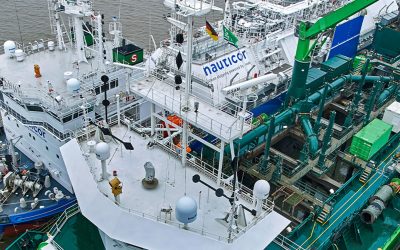
Shipbuilding: The FTA creates immediate export advantages for the German shipbuilding and supply industry. The removal of tariffs on machinery and ship components – previously up to 16% – strengthens the competitive position of German manufacturers of propulsion systems, marine machinery and specialised equipment in the growing Indian market. Well-known companies such as MAN Energy Solutions (now Everllence) and Thyssenkrupp Marine Systems have already secured contracts worth billions for the Indian Navy – an indication of the market potential that easier market access through the FTA could further unlock. At the same time, the state-supported expansion of Indian shipbuilding capacity carries the medium-term risk that India will become a competitor in specialised shipbuilding. Furthermore, complex rules of origin will result in significant compliance costs for small and medium-sized enterprises (SMEs).
Shipping: Stronger trade relations between the EU and India generate additional volume potential for container, breakbulk and specialised cargo traffic. Trade facilitation rules and digitalised customs interfaces measurably reduce transit times on the Europe-India route. At the same time, the agreement significantly increases the pressure to adapt to regulatory changes: the parallel application of CBAM, EU ETS, FuelEU Maritime and FTA rules creates a level of complexity that presents companies with substantial management challenges. The geopolitical situation in the Strait of Hormuz and the Red Sea remains a structural risk for the trade route.
Ports and Logistics: India’s digital transformation in the port sector – driven by the Sagarmala programme and extensive public-private partnership projects – is opening up new market opportunities for German technology and logistics service providers. However, the digital transformation also acts as a competitive factor: Indian IT service providers could make inroads into market segments where German providers have so far been well positioned.
Skilled workers: Although the mobility of skilled workers and visa facilitation are not formally part of the agreement, the EU and India have signed a Memorandum of Understanding (MoU) on a Comprehensive Framework for Cooperation on Mobility, which is intended to facilitate the free movement of highly qualified professionals, students, researchers and seasonal workers. For Germany’s maritime sector, this can serve as a complement to the primary legal framework for seafarers, the International Convention on Standards of Training, Certification and Watchkeeping for Seafarers (STCW Convention).
Geopolitical context: The analysis places the economic opportunities of the FTA within a geopolitical context. India can act as a strategic de-risking partner for the German maritime industry and help to reduce existing dependencies on Chinese shipyards and supply chains – an aspect that is gaining in relevance in light of increasing geopolitical uncertainties.