


Ms Rapp, what exactly are “initiatives and funding programmes” and why are they important?
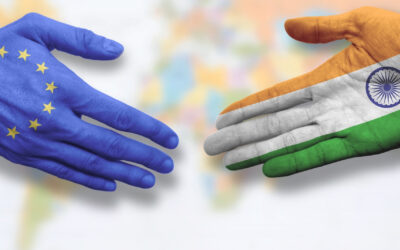
Germany’s maritime sector is integrated into European structures at many different levels. For all players and stakeholders, European exchange is essential. And that is precisely what European initiatives and funding programmes aim to achieve precisely that: they embed Germany’s maritime sector in the European context.
European initiatives and programmes directly impact European countries and set requirements for the sector’s further development – particularly when we consider a Europe that aims to be climate-neutral by 2050. The sector has to transform in terms of fuels and many other aspects. In this respect, Europe does not leave countries and companies to deal with such challenges alone but provides funding programmes to support these efforts and enable the development and implementation of innovations that will help to achieve policy objectives and put them into practice.
Could you summarise what your day-to-day work involves?
A key part of my role is my work around Waterborne, an industry-oriented platform on the European level in which the German Maritime Centre is represented as a member. As part of a co-programmed partnership under the Horizon Europe funding programme – “Zero Emission Waterborne Transport” – we collaborate with the European Commission to develop funding programmes for the maritime sector, including identifying topics, shaping calls and providing technical foresight into the sector’s future.
In addition, I am responsible for the ongoing management of our tool, the “Maritime Funding Compass”, which presents European funding programmes and calls in a clear, user-friendly way. This information platform is constantly being updated with new content. This involves not only entering data, but also understanding when and how programmes are published, which areas they cover, and so on. At the same time, we analyse German participation in the funding programmes.
You haven’t always worked within the maritime industry?
I am a geographer, and I originally studied human geography in Mainz. I then worked as a research associate on various research projects and in teaching. I was also involved as a project manager in the European Social Fund project “Ada Lovelace”, which focuses on supporting and mentoring female STEM students. It was through this project that I discovered my enthusiasm for European project work. It’s great when funding is made available by the EU, but also by the German federal states to support projects that create real added value for society.
Through this project I already had some exposure to European topics and to my current field of work. My first experience with the maritime sector came through a research project on cruise tourism, in which we investigated why cruises are so popular. In terms of content, it wasn’t only about cruise passengers’ perceptions; it also covered port systems, route planning and logistics – so that’s where I got to know the maritime sector as well.
Why are cruises so popular?
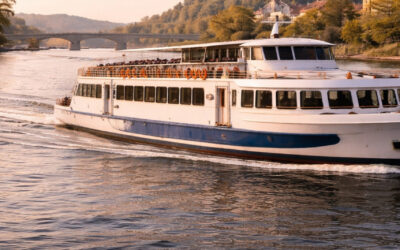
There are many reasons. A cruise ship is a destination in its own right. In a very small space you’re offered everything you need and more. At the same time, places and landscapes pass by right before your eyes. And a lot also has to do with how cruises are portrayed in the media. Thin of the popular German TV show “Das Traumschiff”. People want to feel as if they are in a film.
How did those first maritime points of contact lead to you starting at German Maritime Centre?
After many exciting years in research, I was asking myself whether I wanted to stay in this work field or not. I decided I wanted to try something different, outside of academia. I re-evaluated my passions and interests, and the EU dimension was very important to me. I enjoy working internationally and interdisciplinarily – I think there’s a lot to be gained from interdisciplinary work. It became clear to me: I wanted to work with European initiatives and funding programmes. Initially, I wasn’t specifically looking at the maritime sector. My focus was on the EU connection – but the position at German Maritime Centre suited that perfectly and sounded exciting straight away.
In my current field of work, I see many touchpoints with my earlier career – not only European topics, but also, for example, geography, which deals with bodies of water and with how people interact with the sea.
How do you experience cooperation within the maritime sector at European level? What are the opportunities and challenges?
The great thing about European cooperation is getting to know the various players from other countries. Everyone shares the interest of transforming the maritime sector. There are incredibly innovative people involved who have brilliant ideas. I keep having real “aha moments” and would never have considered certain perspectives otherwise. I can also take many ideas back into the German Maritime Centre. This is what I find genuinely enriching about this work.
At the same time, of course, everyone has their own agenda and their own interests. At Waterborne in particular, the stakeholders involved are very diverse. Industrial companies, research institutes, associations, and many others naturally come together with different expectations and perspectives. This makes our work very wide-ranging, but also exciting. You have to keep finding common ground.
Could you give an example of such an “aha” moment?
Due to my background in research, I sometimes tend to adopt the perspective of a research institution. The perspective of industry companies in the sector is therefore repeatedly enriching, because to them, different aspects are relevant: How much staff needs to be available for a research project? How much effort does the funding application involve? How are additional hours handled? These viewpoints were very eye-opening for me. If you also take this perspective into account, you can optimise research-related processes for everyone involved.
Do you think the maritime sector’s role at European level is significant enough?
The maritime sector already plays a significant role within EU policy. Of course, there is always room for improvement. But I do think the maritime sector is a key issue for the EU. For example, the European Maritime Industrial Strategy is currently being developed, as is the European Ports Strategy. Politically, quite a lot is happening. Clearly, anyone who wants to be climate-neutral and competitive has to do something for the relevant stakeholders in Europe.
What change would you like to see in your field of work?
Occasionally, I would like to see a more pragmatic approach to problems and challenges. Sometimes it would be good to set personal or national interests aside in order to consider directly at the broader benefits of a measure. But I would like to see a more pragmatic approach not only at the EU level, but also in German policymaking – and, more broadly, across the maritime sector.