


Mrs Hornig Jörgens, what are your responsibilities as “Head of Topics and Projects”?
As a think tank, the German Maritime Centre addresses relevant issues in the maritime industry with a very holistic approach. What are the fuels of the future? How much of those will we need? How do we attract young talent? How is critical maritime infrastructure protected? Our team of researchers and advisors works on these and many other questions. As Head of Topics and Projects, I support my colleagues in implementing their projects. I help them prioritise aspects and ensure their work fits into our overall strategy.
In addition, I work closely with our management on the overarching strategic and content-related direction of the German Maritime Centre. We consider which projects to focus on and in what timeframe, what is currently important, and so on. I also work on my own projects, but most of my time is spent collaborating with my colleagues on their current work.
On what basis are overarching decisions made at the German Maritime Centre?
As an organisation, our direction is set by the board and the members. We also have a work plan that guides our activities. Within this framework and based on the work plan, we decide which projects take priority.
Which means I don’t make overarching decisions myself. Instead, I am responsible for the content-related implementation of the work plan. And I examine this very closely. When should we collaborate with external service providers, and what can we handle ourselves? How does one project relate to another? Are there directions we haven’t yet explored? Where is a closer look needed? These are the questions I ask myself, and they define my tasks.
Is there a typical working day for you?
No. Every day is different; there’s always something new happening. But I do make sure that my door is always open and that I’m available to everyone. I sometimes get deeply involved in a project and can draw on my years of industry experience and contacts – and within German Maritime Centre, I’ve been part of the team the longest.
So I just go with what the day brings while also thinking in larger steps: where do we want to be in a year, or in a few months with a project?
What do you mean when you say you’ve been at German Maritime Centre the longest?
I’ve known the German Maritime Centre since its beginnings. I have been actively involved since 2019, initially as an advisor for shipping. Since 2022, I have been Head of Topics and Projects.
You didn’t always work in an office, for a long time ships were your workplace. Could you briefly outline your maritime career?
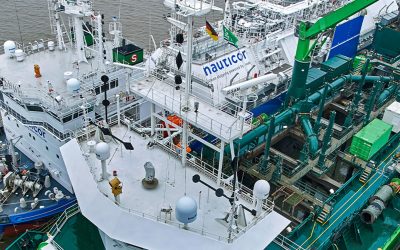
I first went to sea at 16 through the holiday shipping programme of the German Shipowners’ Association. I quickly got the “taste of it,” as they say, and realised I wanted to pursue this career. I studied Nautical Science and worked my way through until I got a certificate of competence as captain.
After my seafaring career, I studied law and worked simultaneously for a large shipping company in Hamburg. I then worked full-time for a period at the German Shipowners’ Association, and since 2019, I have been part of the German Maritime Centre. And my current position is a unique convergence for me: I know the seafaring side, I know the shore-side, I know employer representation. Here, it all comes together, as the German Maritime Centre uses a truly holistic view of the maritime sector and how its various components interconnect.
You were the first female nautical officer on container ships sailing worldwide for the shipping company Hermann Buss?
Yes, I worked on container ships worldwide. I had a permanent vessel that operated between North and South America, the Mediterranean, and Northern Europe. One voyage took about ten weeks, and two voyages made up a full deployment, so you’d return home after roughly five months and then have two months’ leave.
Is there anything you miss about life at sea?
Sometimes I miss the silence in the middle of the ocean. When crossing the Atlantic with no other ships in sight, all you could hear were the engine and the waves – nothing else. That is something I occasionally miss. It was also special not being constantly bombarded with information. Nowadays, thanks to the internet, it is possible to know everything within seconds; at sea, it wasn’t like that. Apart from truly big news, many minor things would simply not reach you for a while, which was liberating in a sense.
Nevertheless, I am happy not to go to sea anymore and to be here at the German Maritime Centre. I believe those were the right decisions for me – and I would always recommend listening to your instincts and making decisions accordingly.
How do your maritime experiences and contacts contribute to your current work?
They help enormously in giving me a practical perspective. I sometimes see myself as a “translator”. I can explain the practical side to someone handling regulations and, conversely, explain regulations to practitioners. The same goes for bridging the perspective of a shipping company and those who actually go to sea.
This helps create mutual understanding and anticipate arguments, making collaboration easier. For our work, it’s essential that everyone communicates with each other.
What advice would you give to young people (“landlubbers”) wanting to enter the maritime sector?
Good starting points for information and advice include the maritime associations, employment agencies, the Maritime Training Centre, or chambers of commerce and industry.
Other than that, I would definitely advise young people to get hands-on experience in the sector and see what suits them. Sometimes persistence is required, and you shouldn’t be discouraged by silly remarks, which exist in every sector. Ultimately, it’s worth pursuing a dream and finding ways to turn it into reality.